Anaconda Largest Snakes of Amazon Jungle Facts - The Anaconda is a notable animal group or Species in the present culture. Motion pictures, books, and the web gloat the risks of this "creature like" snake. In any case, are these gossipy tidbits genuine? You may think about whether you'll discover the Anaconda wind amid your Amazon waterway journey. Before you reluctantly gather your packs to the Amazon wilderness, here are a couple of shocking Anaconda actualities you should know.
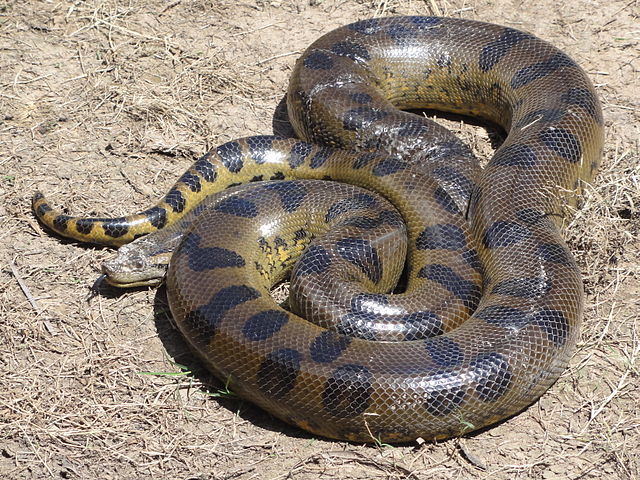
1. The Name Anaconda
The name Anaconda (or Eunectes) wind alludes to a gathering of snakes found in the tropical districts of South America. Four species are right now perceived by the name, Eunectes, which implies great swimmer. The Green Anaconda (Eunectes murinus) is the most surely understood of these four species, and it is typically what rings a bell when you picture the expansive snake. Truth be told, it is the biggest of the Anaconda family.
2. How Big are Anaconda Snakes?
Numerous legends and legend flow around the length of the Giant Anaconda. The Green Anaconda, or Eunectes murinus, is the heaviest, biggest and longest snake in South America, growing up to 5 meters long (17 feet). Regarding measurement and weight, it's not just the biggest in South America and the Amazon rainforest, however in the World. For length, in any case, the Python takes the title of the longest snake.
Amid the times of President Teddy Roosevelt, the Wildlife Conservation Society offered a $50,000 reward to any individual who could convey a live snake estimating more than 30 feet long. The offer ended in 2002, to dishearten individuals from exasperating these creatures from their characteristic natural surroundings.
3. The Smallest Anaconda
The littlest types of Anaconda, the Yellow Anaconda (Eunectes notaeus) measures to be 3-4 meters long (that is still a significant vast snake!). The females become bigger than the guys and both live in amphibian environments. While out on an Amazon wilderness walk, watch out for bogs and swamps, perhaps you will be sufficiently fortunate to see an Anaconda wind topping through.
4. The Rarest Anaconda
The other two types of Anacondas, the Dark-Spotted Anaconda (Eunectes deschauenseei) and the Bolivian Anaconda (Eunectes beniensis), are very uncommon, and little is thought about them, however, they both have evaluated estimations of 15-16 (approx. 5 meters) feet long. Like the name proposes, Bolivian Anaconda can be found in the Bolivian Amazon rainforest while the Dark-Spotted Anaconda meanders around the Brazilian Amazon.
5. The Giant Anaconda Legend: True or False?
False. The informal species should have the capacity to surpass 40-60 feet long and is supposedly seldom observed. Tragically, (or maybe luckily), this snake of legendary extents isn't genuine. At any rate, its reality has never been checked. There used to be, a now wiped out, types of colossal snake known as the "Titan Boa". It looked somewhat like the Anaconda and shared comparable natural surroundings. It isn't unimaginable (just exceedingly far-fetched) that a portion of the "Goliath Anaconda" sightings were in reality simply remarkable surviving Titan Boa sightings.
Generally, however, the Anaconda is a gigantic snake– just not exactly the length a few people have made them out to be. Or maybe, an intriguing Anaconda truth is that they are formally the biggest snake on the planet, which means they are the most intensely worked of any snake alive today. The heaviest Anaconda was a Green Anaconda that tipped the scales at a huge 97.5 kg (215 lb).
6. Boa constrictor's Relationship with Humans
The Anaconda has been given an awful notoriety throughout the times of being a "man-eater", because of films and media. Indeed, even in Amazonian old stories, the Giant Anaconda wind is called an "Encantado," a shapeshifting legendary animal known for hijacking people they experience passionate feelings for. While there have been claims and phony photographs of Anacondas eating people, it is unsubstantiated, and most certainly not genuine. There was some mix as of late finished a Discovery Channel exceptional called, "Eaten Alive", where a naturalist wearing a snake-confirmation suit should be eaten by a Green Anaconda.
The Anaconda wasn't inclined to eat the naturalist by any stretch of the imagination, was startled and attempted to get away. The Anaconda just assaulted him after much incitement. Numerous individuals swung to Social Media to express their shock of this reckless trick, censuring Discovery Channel for airing something so totally out of logical nature that would make hurt the creature.
That being stated, while an experience with an Anaconda snake could be risky, it is profoundly implausible that the Anaconda would endeavor to chase or eat you.
7. What do Anacondas Eat?
All in all, what do Anacondas eat? With regards to the Amazon natural pecking order, every one of the four Anaconda species is basically to finish everything, with their exclusive predators being the incidental Caiman or Jaguar. The larger part of a Green Anaconda's prey is fish, winged creatures, and little warm-blooded animals which wander excessively close towards the water's edge.
They incidentally eat different reptiles also, including different Anacondas! The purpose of savagery among the species isn't exactly comprehended, other than it typically happens when a bigger female eats a little male– that is nature for you! It is likewise obvious that Green Anacondas are equipped for eating bigger creatures, for example, Capybaras, Tapirs, and even Caimans, however, they tend not to do as such all the time. The Yellow Anaconda's eating routine comprises an indistinguishable nourishments from its bigger cousin, however, it likewise has a desire for feathered creatures' eggs and fish flesh. It's sheltered to state the Jaguar has the rivalry for its King of the Jungle title.
8. Are Anaconda Snakes Venomous?
Probably not, Every one of the four types of Anaconda isn't venomous and rather utilize tightening to stifle their prey. At the point when an Anaconda sees its prey come down to the water's edge, it will swim rapidly yet discreetly towards it, keeping simply outside of anyone's ability to see. At the point when the time is correct, an Anaconda will strike, utilizing its hugely solid body, and contract the creature until the point when the unfortunate casualty kicks the bucket of suffocation.
One of the more discussed boa constrictor realities that are genuine is the way an Anaconda can then "unhinge" its jaws keeping in mind the end goal to swallow such huge prey. The reason an Anaconda is fit for overseeing such an accomplishment is on the grounds that it's lower jaw isn't melded to its skull. This makes for one gigantic nibble. After a dinner the span of an expansive warm-blooded creature, an Anaconda won't have to eat again for quite a long time.
9. Where Can I discover an Anaconda?
Each of the four types of Anaconda can be found all through South America, however, they abide predominately in the Amazon and Orinoco stream bowls. Boa constrictors are semi-amphibian and flourish in moderate moving streams, waterways, and other sloppy, damp conditions.
These "Water Boas", as Anacondas are at times called, tend be moderate and inconvenient while ashore, and rather utilize their smooth bodies to swim quickly through the water.
Boa constrictors are essentially nighttime snakes, however, can be seen as dynamic for the duration of the day. An intriguing Anaconda truth is that their eyes and nasal openings are higher up on their head than general winds. This clever component takes into account them to stalk their prey while remaining almost submerged underneath the water's surface.
10. Boa constrictor Snake Behavior

Boa constrictors are singular snakes and just social gathering amid the mating season which happens amongst April and May. Amid this time the snakes will gather together in odd groups known as "reproducing balls", where up to twelve guys will endeavor to mate with one female. These "moderate movement wrestling matches" can keep going for more than a month on end!
A female Green Anaconda can bring forth 60-100 live youthful. Child Anacondas are just two feet long and get no maternal sustaining growing up. Throughout the following couple of years, the Anacondas will develop to huge extents until the point when they achieve adulthood, and soon thereafter their rate of development will definitely diminish. Each of the four types of Anaconda has the life expectancy of around 10 years in nature. Amid this time they could ever imagine, these snakes will develop to end up one of the biggest and most famous on the planet. Dangerous– however fascinating– the Anaconda is certain to be one snake you won't overlook in a rush.
This is the time to explore one of the largest River The Amazon River. Amazon Jungle is fulfilled with wonders of the natures like Amazon's River, Rainforest, Animal's I mean Amazon's rare wildlife etc. The nurturing water of the Amazon River is one of South America's most noteworthy attractions. Consistently, a huge number of individuals tons of every kind imaginable and journey along this watery street looking for the enterprise. Bordered on either side by the most amazing rainforest of the planet, the waterway is only great. The length of the Amazon River is regularly a point of exchange.

For quite a while the Nile River that goes through a huge part of
Africa was viewed as the longest stream on the planet at a length of 4,258
miles. Nonetheless, a gathering of Brazilian researchers as of late proposed
that the Amazon River should take this title. Estimating the length of a
waterway may appear like a simple activity however in actuality this assignment
is full of challenges. It can likewise be trying to work out where the mouth of
a vast waterway is.
The Trendy reply to the question "To what extent is the Amazon
River?" is 4,345 miles or 6,992 km.
On the off chance that we are to acknowledge the Brazilian
researchers' hypothesis that the Amazon River is the longest on the planet, it
would imply that the mouth can be found on the south side of Marajó Island.
This implies the waterway incorporates the Pará River and is an incredible
4,345 miles in length. The negating and more conventional school of thought is
that the Pará River has a place with the Tocantins River, not the Amazon.
Without this additional extension of water, the Amazon would quantify around
3,980 miles long. The open deliberation as to which waterway is longer is as yet
in progress – possibly, later on, there will be an all-inclusive understanding
as to which stream rules, yet meanwhile it stays questionable.
While the length of the waterway is as yet misty, various
researchers have said that the length of a stream doesn't really make a
difference. What is substantially more vital to know is the seepage zone. The
seepage region, likewise known as the waste bowl or the catchment territory is
a term for the land that adds to the waterway. As it were, it is the place the
waterway's water originates from – snowmelt, rainwater and water system that
isn't retained once again into the land. The aggregate seepage zone of the
Amazon River is 2.7 million square miles. As such, the Amazon seepage bowl is
just a little piece littler than the whole zone of Australia. Also, inside this
colossal scope of water, you can discover 20% of the world's freshwater supply
– making the Amazon River the greatest stream on earth, paying little heed to
what extent it might possibly be.
One other thing that the Amazon River wins the pass on is the
title for world's fastest stream. In the stormy season, the width of the
waterway stretches out to around 25 miles. To put that consider along with a
point of view, on the off chance that you could stroll over the waterway it
would take you around 8 hours to get from one side to the next! Indeed, even
the Nile River at its most extensive just measures around 4.6 miles. In the dry
season, the Amazon River still measures a titanic 6.8 miles, totally
overshadowing the Nile. That is one relentless waterway we have staring us in
the face here.
The Amazon River winds its way through Brazil, Colombia, Ecuador,
Peru, and Bolivia and is basic for keeping up life in these nations. The yearly
flooding of the waterway keeps the verdure pleasantly hydrated and gives water
to groups that live along the riverbanks. The stream is likewise home to
various staggering creatures, including the Amazon River dolphin, Amazonian
manatee, and the monster otter.
In the event that your enthusiasm for the Amazon River has been
aroused by so much discussion about its greatness then you should need to think
about setting aside the opportunity to investigate it. With deforestation
running wild and environmental change wreaking devastation around the world,
there is no knowing how much longer we will have the chance to investigate the
Amazon Rainforest. There is no time like the present to jump on an Amazon River
voyage, listening the delicate lapping of the water and the calls of the
tropical feathered creatures that call this district home. On the off chance
that you need an affair that you will always remember, look no more remote than
the Amazon River. Get up and Call your Tour planner today to see Amazon Jungles with your own eyes


